
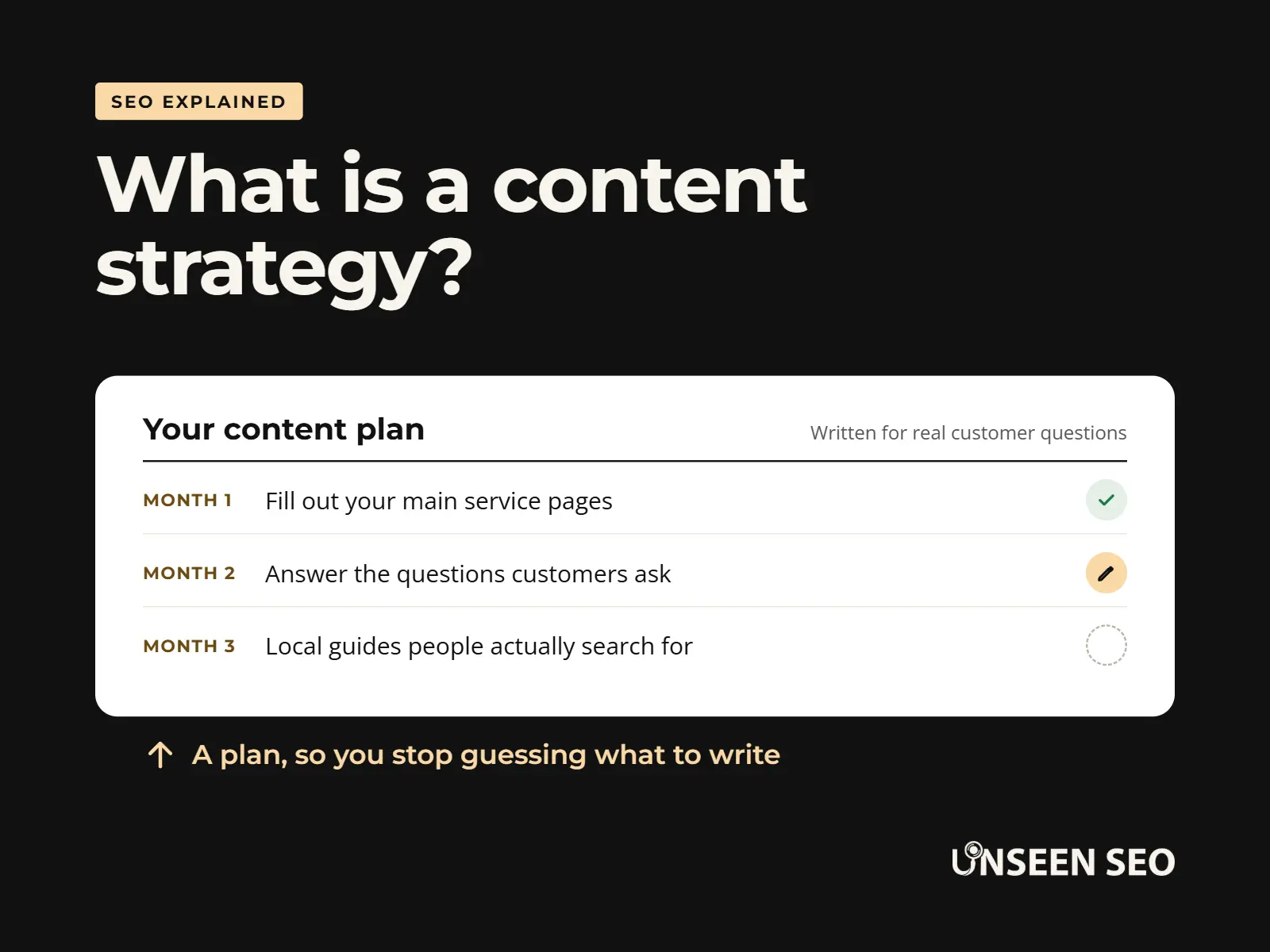
A content strategy sounds like something only a big marketing team would need. It isn’t. At its simplest, it’s just a plan for what you write on your website and why, so nothing you publish goes to waste on a page nobody was searching for.
What is a content strategy?
A content strategy is a plan for the content your business puts out (blog posts, service pages, social captions, whatever you use), built around what your customers are actually searching for and what you want them to do once they land on the page. Instead of writing whatever comes to mind that week, you decide in advance what to write, who it’s for, and what it needs to achieve.
Google rewards this too. A website with a plan behind it, one that answers the questions customers genuinely ask, in a sensible order, tends to do better than one with a handful of random posts. It reads like it was written by someone who knows the subject, because it was.
What actually goes into a content strategy?
You don’t need spreadsheets or a marketing degree for this. A proper content strategy plan usually covers five things:
- Who you’re talking to. The sort of customer you want more of, and what they’d actually type into Google to find you
- What each page needs to do. More enquiries, more phone calls, better rankings for a specific search, or simply building trust
- The topics worth covering. Based on real searches, not guesswork
- How often you’ll realistically publish. A schedule you can stick to beats an ambitious one you abandon after a fortnight
- A quick way to check what’s working. So you can do more of what’s landing and drop what isn’t
Say you run a plumbing business in Sheffield. Rather than posting whatever comes to mind, a content strategy might mean a page on emergency callouts, one on boiler servicing costs, and a few honest answers to the questions people actually search before calling a plumber. Small, focused, and aimed at real searches, not a wall of content for the sake of it.
Content strategy vs just posting when you remember
Most small businesses already create some content: a few blog posts, an about page, maybe the odd social update. What’s usually missing isn’t effort, it’s direction. Posting because you feel like you should is the digital equivalent of shouting into an empty room and hoping someone’s listening.
A content strategy doesn’t mean writing more. Often it means writing less, but writing the right things: the pages and posts your customers are genuinely looking for, instead of whatever felt like a good idea on a Tuesday afternoon.
It also doubles up as your SEO content strategy (SEO just means the things that help your site show up in Google search results), since the two are really the same job done properly.
Does my small business actually need one?
Probably not the kind of content strategy a big company would build, with sign-off meetings and a 50 page document nobody reads twice. But some kind of plan, yes, even a scrappy one.
Without it, you might still show up when someone searches your business name. What you’ll likely miss is the bigger opportunity: people searching for the problem you solve, who’ve never heard of you yet. And with more people starting their search on AI tools as well as Google, having genuinely useful content on your site matters more than ever, not less.
For most small businesses, a good content strategy is a short list of the topics and pages worth having, in the order that matters most, plus a realistic idea of how often you can actually add to it. That’s it. No swimlanes, no stakeholder sign-off, just a plan you can actually follow.
How we can help
If putting a content strategy together yourself sounds like one more thing on an already long list, that’s exactly what our Content Strategy service is for. We’ll work out what your customers are searching for, what’s missing from your site, and give you a plan you can follow yourself, or hand straight back to us.
Have a look at our Content Strategy service for what’s included, or get in touch and we’ll have a chat. No jargon, no pressure.

Leave a Reply