
Search intent is the reason behind a search: what someone actually wants when they type something into Google. Understanding it costs nothing, needs no tools, and is often the difference between a page that ranks and one that doesn’t.
This guide explains what search intent is, the four types (with real world examples), how to work out the intent behind any keyword, and how to match it on your own website. There’s even a little quiz. No prizes, sorry, just the warm glow of being right.
Contents
- What is search intent?
- The four types of search intent
- Search intent examples
- Why search intent matters for SEO
- How to work out the search intent of a keyword
- The three C’s of search intent
- Have a go: guess the intent
- How to match search intent on your website
- Common search intent mistakes
- Search intent and AI search
- Common questions
What is search intent?
Search intent (also called user intent) is the goal behind a search. Not just the words someone typed, but what they’re hoping to find once they hit enter.
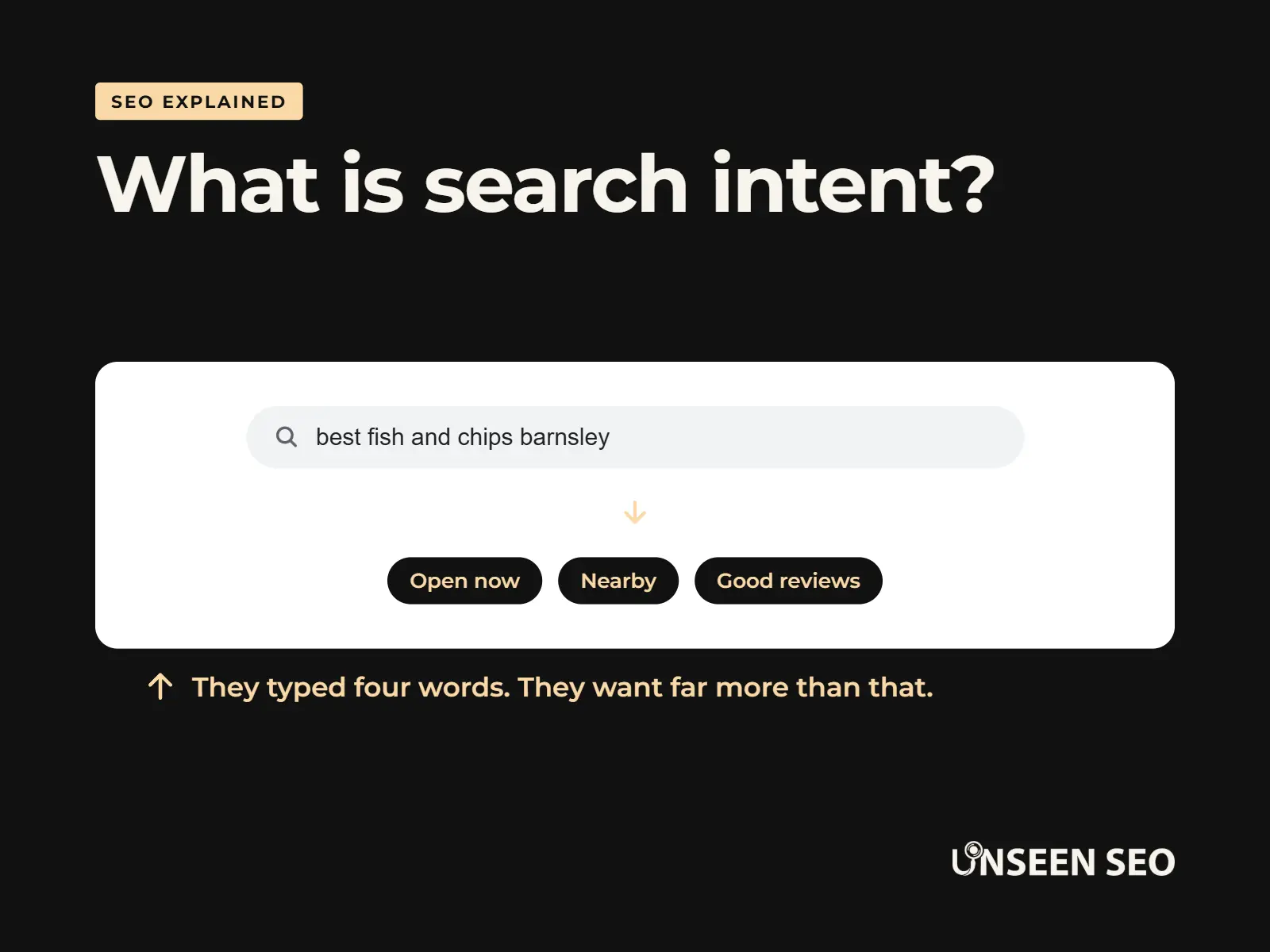
Say someone searches “best fish and chips barnsley”. They’re not after a history of batter. They want a chippy that’s open now, close by, with good reviews. Four words typed, a whole list of wants behind them.
What they typed
What they actually want
That’s why Google shows a map and a list of nearby chippies, not an essay.
Google has got very good at working out intent. It wants searchers to find what they came for, so it shows the kinds of pages that best match what people want for that search. Your job is to make sure your page is genuinely that answer, not just a page that happens to use the same words.
What is search intent in SEO?
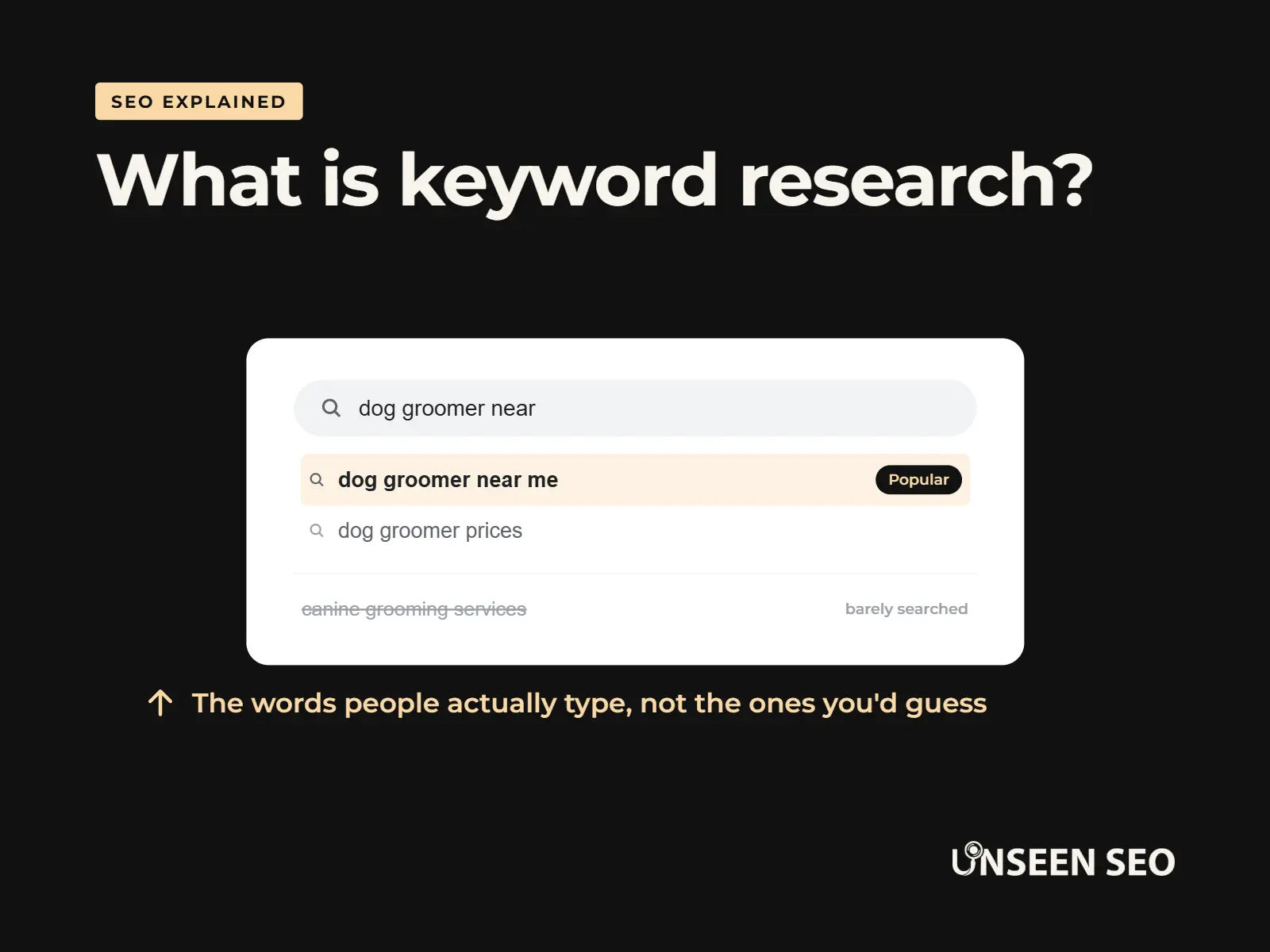
In SEO (getting found on Google), search intent is about matching each page on your website to the intent behind the searches you want it to show up for. It’s the other half of keyword research: keyword research tells you what people type, search intent tells you what they want. You need both.
The four types of search intent
Most searches fall into one of four types. Each one calls for a different kind of page.
1. Informational
They want to learn something.
“how often should I service my boiler”
Clue words: how, what, why, guide, ideas
Best page: a blog post or guide
2. Navigational
They want to get to a specific website or page.
“smith and sons plumbing”, “facebook login”
Clue words: a business or brand name, login, contact
Best page: your homepage or contact page
3. Commercial
They’re comparing before they decide.
“best wedding photographer sheffield”
Clue words: best, reviews, vs, cost, compare
Best page: a service page with prices, reviews and examples
4. Transactional
They’re ready to act: buy, book or call.
“book mot doncaster”, “emergency plumber near me”
Clue words: buy, book, order, price, near me
Best page: a service or product page with a clear way to book
Some guides add a fifth type: local intent, where someone wants something nearby. It’s really a flavour of the other four (usually commercial or transactional), but for a small business it’s the one that matters most. Searches with a town or “near me” in them often show a map with three businesses, called the local pack, and that’s where a good Google Business Profile earns its keep.
Navigational search intent
Navigational searches are the easiest to overlook. When people search your business name, they’re trying to reach you. You can’t win other businesses’ navigational searches, but you should always win your own. If you don’t show up when someone types your name, here’s why that might be.
Search intent examples
Here’s how it looks for a few everyday local businesses. Same trade, very different wants:
| Search | Intent | The page that should answer it |
|---|---|---|
| how to bleed a radiator | Informational | A step by step blog post |
| boiler service cost | Commercial | A service page with clear prices |
| boiler service rotherham | Transactional (local) | A local service page and a Google Business Profile |
| smith and sons plumbing | Navigational | Your homepage |
| what is a combi boiler | Informational | A short, plain English explainer |
| best plumber rotherham reviews | Commercial (local) | Your Google Business Profile reviews and a reviews page |
Notice the plumber needs different pages for different searches. One page can’t be a guide, a price list and a booking page all at once (well, it can try, but it won’t do any of them well).
Why search intent matters for SEO
Search intent matters because Google ranks the pages that best match what people want, not the pages that repeat the search words the most. Get the intent wrong and even a beautifully written page can struggle to rank.
- You rank more easily. A page that matches the intent is the kind of page Google is already choosing to show.
- Visitors stick around. People who land on what they wanted read, call and book. People who don’t, hit the back button.
- You get better customers. Matching transactional searches with clear service pages brings in people ready to buy, not just browsers.
- You stop wasting effort. No more writing pages that were never going to rank for the search you had in mind.
It’s also why exact keywords matter less than they used to. Google understands that “chippy near me” and “fish and chip shop nearby” want the same thing. Answer the need, and the wording takes care of itself.
How to work out the search intent of a keyword
You don’t need a search intent tool for this. Some paid SEO tools will label intent for you, but the most reliable method is free: ask Google. Here’s how, in about ten minutes and one cup of tea.
1. Read the words
The search itself often gives the game away. “How”, “what” and “why” usually mean informational. “Best”, “reviews” and “vs” usually mean commercial. “Book”, “buy”, “price” and “near me” usually mean someone is ready to act. A business name means navigational.
2. Google it and look at what ranks
This is the big one. Google has already worked out the intent for you, and the results page is its answer. Use a private browser window so your own search history doesn’t skew things, then look at:
- The type of pages: blog posts, service pages, product pages or a business’s homepage?
- The extras: a map with three businesses means local intent. Shopping results mean people want to buy. Videos mean people want to be shown how.
- People also ask: the box of questions tells you what else people want to know.
3. Ask what happens next
Picture the person searching. What would make them happy? A phone number? A price? A step by step guide? A comparison? Whatever comes next is what your page needs to make easy.
4. Watch for mixed intent
Some searches are mixed. “Boiler service” could mean “how much is one?” or “book one now”. When the results show a mix of guides and service pages, Google isn’t sure either. That’s a good sign a service page with clear prices and a short explanation can cover both.
The three C’s of search intent
A handy way to match intent is to check three things about the pages already ranking. You’ll see different versions of the three C’s online, but this is the most common:
| The C | What to look at | Example for “how to bleed a radiator” |
|---|---|---|
| Content type | What kind of page ranks: blog post, service page, product page, video | Blog posts and videos |
| Content format | How it’s laid out: step by step guide, list, comparison, review | Step by step guides |
| Content angle | The hook that makes it appealing: quick, for beginners, cheap, local, up to date | Quick and simple, often “in 5 easy steps” |
Match the type and format, then pick an angle that suits you. For a small business, an honest, local, plain English angle stands out surprisingly well against the big national websites.
Have a go: guess the intent
Have a guess at each one, then tap to see the answer.
“cake shop near me”
Transactional (local)They want a nearby shop, today. Google shows a map, so a Google Business Profile matters most.
“how much does a wedding cake cost”
CommercialThey’re weighing up options before buying. A page with clear price guides wins here.
“how to stop a cake sinking in the middle”
InformationalThey want to learn. A friendly how to blog post is the right fit.
“smith and sons bakery”
NavigationalThey want one particular business (a made up one, in this case). Only that business can really win it.
“best birthday cakes doncaster”
Commercial (local)They’re comparing local options. Reviews, photos and prices help them pick you.
Want more practice? There’s another quick intent quiz in chapter 5 of our SEO for beginners guide.
How to match search intent on your website
Once you know the intent, matching it is mostly about giving each search the right kind of page. For most small business websites, that looks like this:
| Intent | Page to use | What it needs |
|---|---|---|
| Transactional | Service or product pages, one per service | Prices (or a starting price), areas covered, and a big, obvious way to call or book |
| Commercial | Service pages, pricing pages, reviews | Honest prices, real reviews, photos of your work, and why people pick you |
| Informational | Blog posts and guides | A clear answer near the top, then the detail, with a gentle link to your services |
| Navigational | Homepage and contact page | Your business name, what you do, where you are and how to reach you |
| Local | Google Business Profile, plus local service pages | Correct name, address and phone number everywhere, and plenty of reviews |
A few habits that help any page match its intent:
- Answer first. Put the main answer or offer near the top. Nobody wants to scroll past three paragraphs of welcome.
- Make the next step obvious. A guide links to the relevant service. A service page has a phone number people can actually find.
- Write a listing that matches. Your page title and meta description should promise what the searcher wants (“prices from”, “step by step”, “open today”).
- One main intent per page. If a keyword needs a different kind of answer, it probably needs a different page.
Common search intent mistakes
- Writing a blog post for a buying search. “Electrician sheffield” wants a service page and a phone number, not a 2,000 word article.
- Writing a sales page for a learning search. “How to fix a dripping tap” won’t be won by a page that just says “call us”.
- Chasing words, not wants. Repeating a keyword over and over (keyword stuffing) doesn’t fix a page that answers the wrong question.
- Cramming everything onto one page. A homepage trying to rank for every service and every question usually ranks for none of them.
- Forgetting the local pack. For local searches, your Google Business Profile is often seen before your website.
- Never checking again. Intent can shift over time. If a page slips, Google the search again and see what’s ranking now.
Search intent and AI search
AI Overviews and tools like ChatGPT are, in a way, all about intent. They try to answer the need behind a question directly. That makes matching intent even more worthwhile: pages that answer a clear question clearly are the ones these tools tend to draw on.
Google says its normal SEO advice applies to its AI features too, so there’s no special trick. Answer the real question, near the top, in plain English. There’s more in our beginner’s guide to AI search.
Common questions about search intent
Quick answers to the questions people ask most about search intent.
Search intent is the reason behind a search: what someone actually wants when they type something into Google. It might be to learn something, find a particular website, compare options or buy something.
The four types are informational (wanting to learn), navigational (wanting to reach a specific website), commercial (comparing options before deciding) and transactional (ready to buy, book or call). Some people add local intent as a fifth.
“How to bleed a radiator” is informational, “smith and sons plumbing” is navigational, “boiler service cost” is commercial and “book boiler service rotherham” is transactional. Each one needs a different kind of page to answer it.
The three C’s are content type (what kind of page ranks), content format (how it’s laid out, like a list or step by step guide) and content angle (the hook, like quick, cheap or for beginners). You’ll find them by looking at the pages already ranking for a search.
Read the words for clues, then Google the keyword in a private window and look at what ranks. The type of pages, plus extras like maps, shopping results or videos, show you what Google thinks people want.
Yes. Search intent, user intent, query intent and keyword search intent all mean the same thing: the goal behind someone’s search.
Because Google ranks the pages that best match what people want. A page that matches the intent is more likely to rank and to turn visitors into customers. A page that doesn’t can struggle, however good it is.
The 30-second version
Search intent is what someone really wants when they search. There are four main types: learning, finding a particular website, comparing and buying. Google the search, look at what ranks, and give each search the kind of page it’s asking for. Do that, and you’ll often beat bigger websites that just repeat the right words.
Want a hand with it?
Not sure your pages match what your customers are searching for? Our £150 No Nonsense Audit gives you a plain English list of what to fix first, with no retainer and no contract. Need help planning which pages to write? That’s what our content strategy help is for, at £50 an hour. Or just drop us a message with your question.


Leave a Reply