
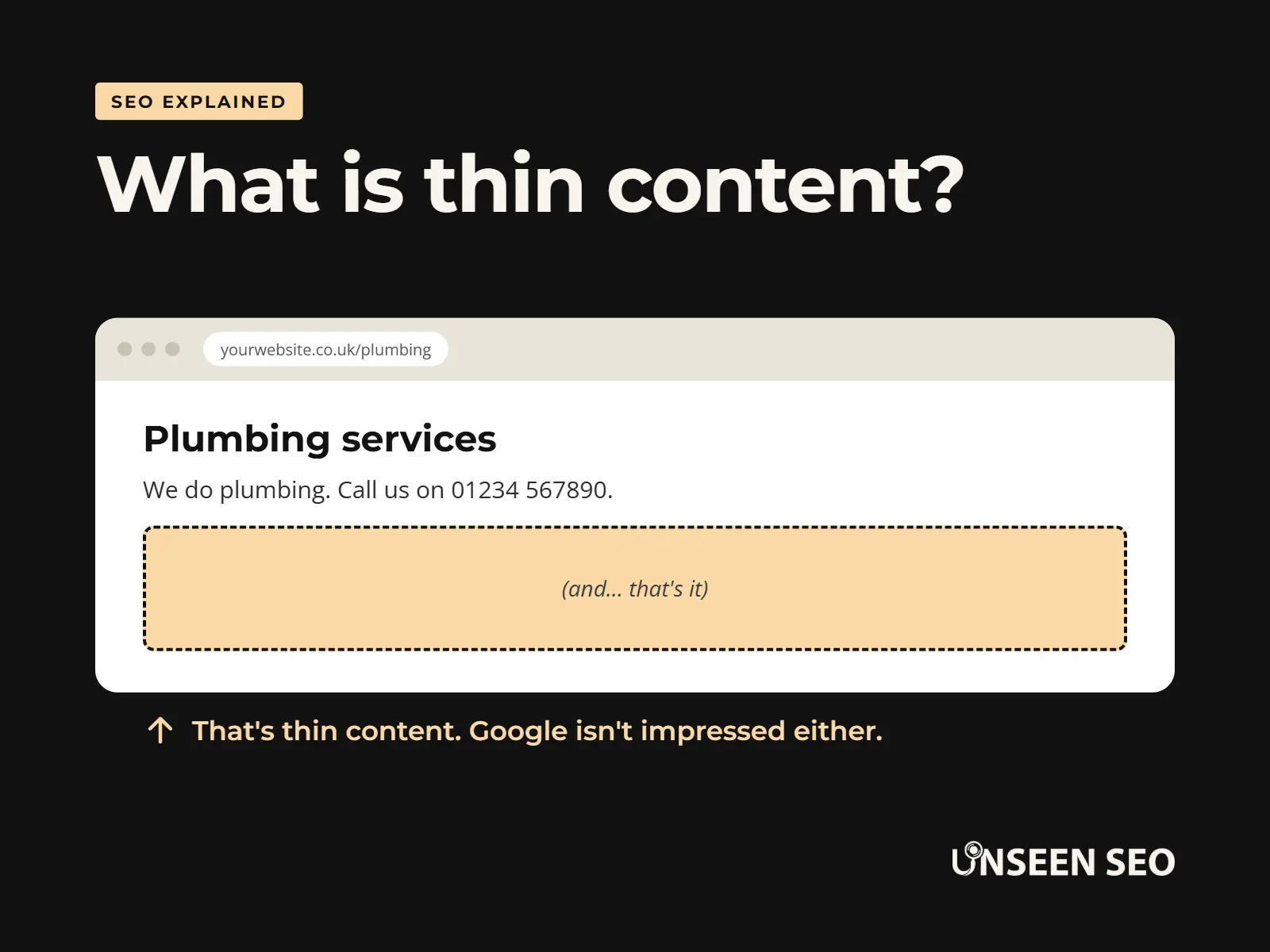
“Thin content” sounds like an insult someone might throw at your website. In reality it’s a simple idea: a page that doesn’t give visitors (or Google) enough to go on. The good news is that it’s usually free to fix, because the cure is mostly writing things your customers already ask you about.
It’s also one of the most common reasons small business websites struggle to get pages into Google at all. So this guide covers what thin content is, how Google sees it, how to spot it on your own website, and exactly what to do about it.
Contents
- What is thin content?
- What is Google thin content?
- Why thin content hurts your SEO
- Common types of thin content
- Thin content vs short content
- What are Google spam updates?
- How to find thin content on your website
- How to fix thin content
- How many words is enough?
- How to avoid thin content in the first place
- Thin content FAQs
What is thin content?
Thin content is any page that gives visitors little or no real value. It might have hardly any words on it, it might repeat what’s already on other pages, or it might be stuffed with words that don’t actually answer anything. Either way, someone landing on it from Google leaves no better off than when they arrived.
The classic small business example is a service page that says something like “We do plumbing. Call us on 01234 567890.” and not much else. Nothing about what jobs you take on, where you cover, what it costs, or why anyone should pick you. It’s a bit like being recommended a restaurant, turning up, and finding the menu just says “Food”.
In SEO terms, thin content matters because Google’s whole job is to show people the most helpful page for what they searched. A page with nothing useful on it is rarely the most helpful page for anything.
What is Google thin content?
Google uses “thin content” in two slightly different ways, and it’s worth knowing both.
1. Thin content as a quality problem
Most of the time, thin content is simply a quality issue. Google’s ranking systems are built to reward helpful, people-first content and to show less of pages that don’t add anything. A thin page isn’t breaking any rules. It’s just unlikely to rank, and it may not get indexed at all.
2. Thin content as a spam problem
At the extreme end, some kinds of thin content break Google’s spam policies. The ones that matter most here are:
- Thin affiliation: pages full of affiliate links where the product descriptions and reviews are copied straight from the merchant, with nothing original added
- Doorway abuse: lots of near-identical pages built to rank for similar searches (think “plumber Sheffield”, “plumber Rotherham”, “plumber Barnsley” pages with only the town name swapped) that funnel people somewhere else
- Scaled content abuse: churning out large numbers of pages mainly to manipulate rankings rather than to help anyone, whether they’re written by people, software or AI
- Scraping: taking content from other websites and republishing it without adding any value
If a site leans heavily on any of these, Google can take a “manual action” against it. That’s a penalty applied by a real person at Google, and it shows up in Google Search Console under Manual actions, labelled “Thin content with little or no added value”. For the vast majority of small business websites this never happens. Thin pages usually just quietly underperform rather than getting anyone into trouble.
Why thin content hurts your SEO
Even without a penalty, thin pages cost you in a few ways:
- They don’t rank. If a page doesn’t answer the question better than the competition, Google has no reason to put it near the top
- They may not get indexed at all. Indexing is Google adding a page to its library of search results. Google doesn’t index everything it finds, and thin pages are often the ones left out. In Search Console, they tend to show up as “Crawled, currently not indexed” or “Discovered, currently not indexed”
- They can drag down how Google sees the whole site. A website with lots of empty or repetitive pages looks less helpful overall, which can make it harder for your good pages to shine
- They waste Google’s attention. Every visit Google spends on a pointless page is a visit not spent on one that matters
- They lose customers. Even if a thin page does get a visitor, it gives them no reason to stay, trust you or get in touch
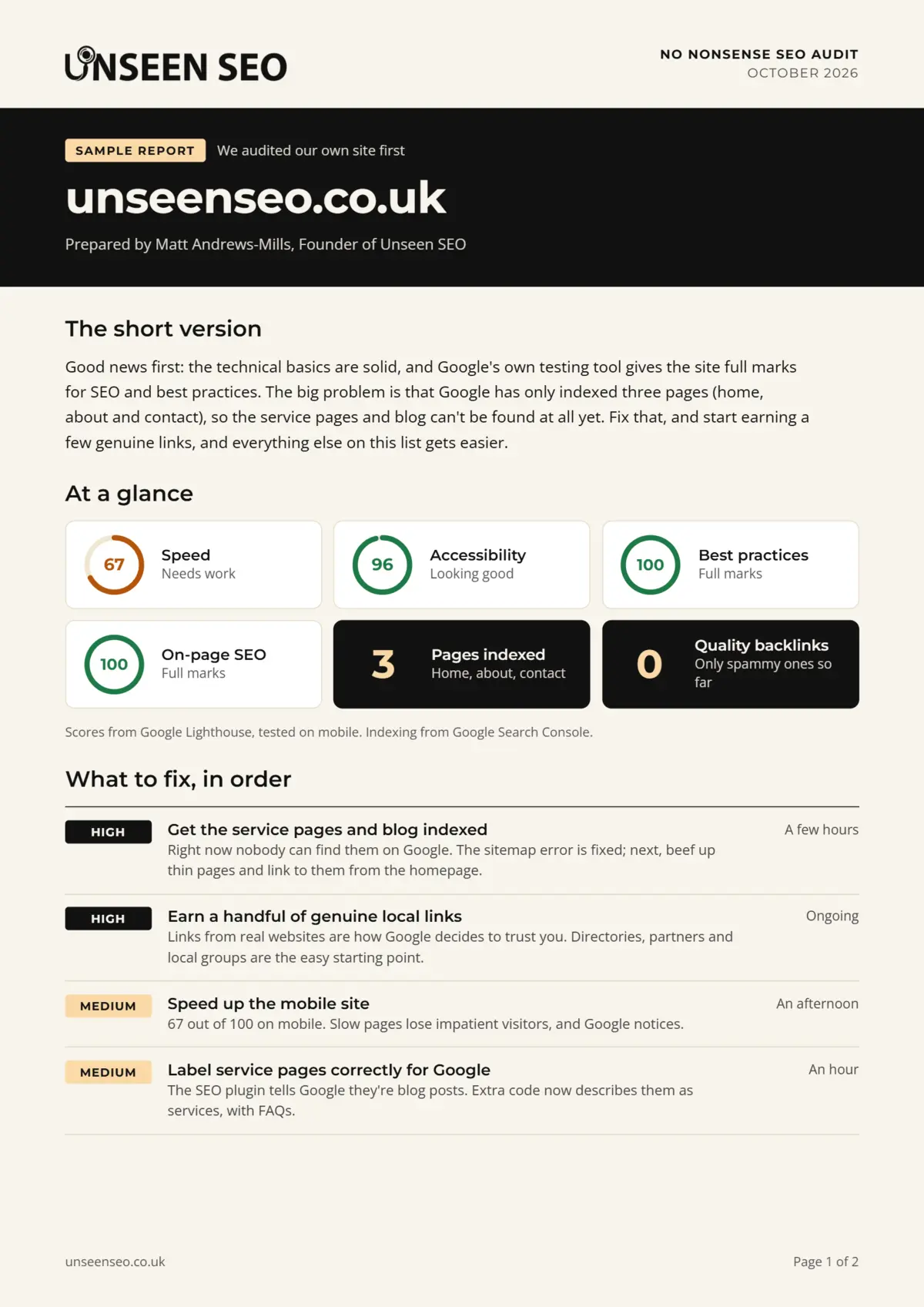
Real example: when we audited our own website, Google had only indexed three pages. A sitemap problem was part of it, but several service pages were also thinner than they should have been. Beefing them up was top of our own to-do list.
Common types of thin content
Here are the kinds of thin content we see most often on small business websites, roughly in order of how common they are.
Near-empty service pages
A heading, two sentences and a phone number. These are the most common thin pages of all, usually because the website was built in a hurry and nobody came back to finish them. They’re also the most important to fix, because they’re the pages that should be bringing you work.
Copy-and-paste location pages
One page per town, each identical apart from the place name. It’s a tempting shortcut for local businesses, but Google can spot it a mile off, and at scale it starts to look like doorway pages. A location page is only worth having if it says something genuinely specific about working in that area.
Copied or manufacturer descriptions
If you sell products and use the same description the manufacturer gives to every other shop, your page adds nothing new. It’s duplicate content, and Google will usually show a different website’s version instead of yours.
Scraped or lightly reworded content
Content lifted from another website, sometimes run through a rewording tool so it isn’t an exact copy. Apart from the copyright question, it adds nothing that wasn’t already out there, which is the definition of thin.
Mass-produced AI content
AI writing tools aren’t the problem in themselves. Pumping out dozens of generic pages that nobody has checked, added real experience to, or tailored to your customers is. If a page could have been written about any business in any town, it probably isn’t helping yours.
Thin blog posts
The 200-word “5 tips for spring” post written because someone said you should blog regularly. One good, detailed post that answers a real question beats ten thin ones every time.
Automatic archive and tag pages
WordPress and other website builders create pages automatically for things like tags, categories, authors and dates. Many of these list one or two posts and nothing else. They’re not something you wrote, but Google can still find them.
Pages buried under adverts or pop-ups
A page where the actual content is a few lines hidden between adverts, banners and sign-up boxes can be thin even if the words themselves are fine.
Thin content vs short content
This catches a lot of people out. Short isn’t the same as thin. A contact page, a page with your opening hours, or a quick answer to a simple question can all be short and still be exactly what the visitor needs.
The question isn’t “how long is it?”, it’s “does this page fully answer what the person was looking for?” That’s called search intent: the reason behind a search. Someone searching “plumber opening hours Sheffield” wants a quick answer. Someone searching “how much does a new boiler cost” wants detail, options and prices. Give the first person a 2,000-word essay and the second person two sentences, and you’ve got both wrong.
Equally, a long page can still be thin if it’s padded out with waffle, repeats itself or is stuffed with keywords (keyword stuffing, which Google really doesn’t like). Word count is a symptom, not the disease.
What are Google spam updates?
Google is constantly running automated systems to spot spam, including an AI-based system it calls SpamBrain. Every so often it makes a notable improvement to those systems and announces it as a “spam update”, listed on Google’s Search Status Dashboard alongside its other ranking updates.
Spam updates target the kinds of practices in Google’s spam policies: scaled content abuse, doorway pages, link spam, scraped content and so on. If your traffic drops sharply around the time of a spam update, Google’s advice is to review its spam policies and make sure your site follows them. It also says recovery can take months, because its systems need time to learn that a site has cleaned up its act.
For an ordinary small business website with honest, if slightly thin, pages, spam updates are rarely the thing to worry about. They’re aimed at sites deliberately trying to game the system. Your thin pages are more likely to be held back by Google’s normal quality checks, which is good news, because that’s much easier to fix.
How to find thin content on your website
You don’t need expensive software for this. A free afternoon and a cup of tea will do it for most small websites.
Step 1: Check Google Search Console
Open the Pages report in Search Console (not set up yet? Here’s how to set up Google Search Console). Look at the pages listed under “Crawled, currently not indexed” and “Discovered, currently not indexed”. Not every page there is thin, but thin pages love to hang out in that list. While you’re in there, check Manual actions too, just to rule out anything serious.
Step 2: Make a list of every page
Crawl your website with a free tool like Screaming Frog (the free version handles up to 500 pages) or Ahrefs Webmaster Tools. Both list every page they find, along with a word count. Sort by word count and look hard at anything at the bottom. Remember, short isn’t automatically thin, but it’s a good place to start looking.
Step 3: Look at how visitors behave
In Google Analytics, look for pages that get visitors who leave almost straight away, or pages that get no visitors at all. Neither proves a page is thin, but both are worth a closer look.
Step 4: Read your pages like a customer would
This is the step that matters most, and no tool can do it for you. Open each important page and ask: if I’d never heard of this business, would this page answer my question and make me want to get in touch? If the honest answer is “not really”, it’s thin.
Step 5: Compare yourself with the competition
Search for the main thing each page is about and look at the top few results. If they explain prices, process, examples and common questions and your page has two sentences, you’ve found your gap.
Thin content is one of the things we check in every SEO audit. Here’s the summary page from the audit we ran on our own website, where thin service pages made the priority list:
How to fix thin content
Once you’ve found your thin pages, each one needs one of five decisions. Here they are, from most to least common.
1. Improve it
For pages that should exist, like your main service pages, this is almost always the answer. Add the things a customer actually wants to know:
- What exactly you do, and what you don’t
- Who it’s for, and the areas you cover
- Roughly what it costs, or what affects the price
- How the process works, from first call to finished job
- Real examples, photos of your own work, and the questions customers ask you most
- A clear next step, so people know how to get in touch
Here’s a quick before and after. Before: “We offer boiler servicing. Contact us for a quote.” After: a page explaining what a service includes, how long it takes, why it matters for your warranty, roughly what it costs, which areas you cover, and answers to “do you service all makes?” and “how often should I get it done?”. Same service, completely different page.
2. Merge it
If you’ve got several thin pages covering much the same thing (three short blog posts about boiler maintenance, say), combine them into one proper page. Then send the old addresses to the new one with a 301 redirect, so nobody hits a dead end and any value the old pages had carries across.
3. Redirect it
If a page has no reason to exist any more, but people or other websites still link to it, redirect it to the most relevant page you’ve got.
4. Hide it from Google
Some pages need to exist for visitors but are no use in search results: thank-you pages, login pages, basket pages, and many of those automatic tag and author archives. Adding a noindex tag tells Google to leave them out of its results without deleting them. Most SEO plugins can do this with a tick box.
5. Delete it
If a page is thin, gets no visitors, has no links pointing to it and doesn’t help anyone, it’s fine to delete it. Just make sure nothing on your own website still links to it, or you’ll create broken links instead.
Whatever you choose, link your improved pages together sensibly. Good internal linking helps Google find your best content and understand which pages matter most.
How many words is enough?
There’s no magic number, and anyone who tells you “every page needs 1,000 words” is guessing. Google doesn’t have a minimum word count.
As a very rough guide, a main service page usually needs a few hundred words at least to cover the basics properly, and a guide answering a detailed question will often run much longer. But the right length is simply however long it takes to answer the question well, and then stop. If you’re adding words just to hit a target, you’re making the page worse, not better.
How to avoid thin content in the first place
- Write each page for one clear purpose, and make sure it answers that fully
- Start from the questions your customers actually ask you on the phone, by email and on site
- Use your own experience, examples and photos: it’s the one thing competitors can’t copy
- Don’t create a page for every town you cover unless you’ve got something specific to say about each one
- If you use AI tools to help write, edit everything properly and add your own knowledge
- Plan new content around what your customers search for, rather than publishing for the sake of it
- Check your pages once a year, as part of a regular SEO audit
If you’d like a proper plan for what to write and in what order, that’s exactly what a content strategy is for.
Thin content FAQs
Quick answers to the questions people ask most about thin content.
Thin content is any web page that gives visitors little or no real value. Common examples are near-empty service pages, copied or duplicated text, near-identical location pages and mass-produced articles. Thin pages tend to rank poorly and are often left out of Google’s index altogether.
Google uses the term in two ways. Usually it simply means low-value pages that Google’s ranking systems are unlikely to show. At the extreme end, practices like thin affiliate pages, doorway pages, scraped content and scaled content abuse break Google’s spam policies, and can lead to a manual action called “Thin content with little or no added value”, which shows in Google Search Console.
Spam updates are notable improvements Google makes to its automated spam-detection systems, including its AI-based system SpamBrain. Google announces them on its Search Status Dashboard. They target practices that break its spam policies, and Google says sites affected should review those policies, adding that recovery can take months.
Very rarely. Manual penalties for thin content are aimed at sites deliberately gaming Google, such as large networks of copied or auto-generated pages. For most small business websites, thin pages simply rank poorly or don’t get indexed, which is fixable by improving, merging or removing them.
There’s no official word count. Google doesn’t set a minimum, and a short page can be perfectly fine if it fully answers the visitor’s question. A page is thin when it doesn’t give people what they came for, however many words it has.
Only if the page has no purpose. Important pages, like your main services, should be improved instead. Pages covering the same topic can be merged and redirected, pages people need but searchers don’t can be set to noindex, and pages nobody visits or links to can be deleted.
It can be. Google doesn’t penalise content just for being written with AI, but mass-produced pages that are generic, unchecked and add nothing new can count as thin, and at scale can break Google’s scaled content abuse policy. Using AI as a helper, then adding your own knowledge and examples, is the safe approach.
Don’t panic
Almost every website has a few thin pages, including ones run by people who do SEO for a living (we had to fix ours too). Thin content isn’t a sign you’ve done something wrong. It’s usually just a sign your website was built faster than it was written, and that’s very fixable.
Want a second pair of eyes?
Not sure which of your pages are thin, or what to add? Our £150 No Nonsense Audit checks every page and tells you, in plain English, exactly which ones need work and what to put on them. Get in touch and we’ll take a look.

Leave a Reply