A backlink is just a link from another website to yours. That’s genuinely it. They’re free to earn, and Google treats them a bit like word of mouth: if trusted websites point to you, it’s a sign you’re worth showing to people.
This guide explains what backlinks are, why everyone in SEO goes on about them, which ones are worth having, and simple ways a small local business can earn them without paying anyone or breaking Google’s rules.
Contents
- What is a backlink?
- Why do backlinks matter?
- Types of backlinks
- Good backlinks vs bad backlinks
- How many backlinks do you need?
- How to check your backlinks
- How to get backlinks for a small business
- What to avoid
- Common questions
What is a backlink?
A backlink is a link on someone else’s website that points to a page on your website. You’ll also hear them called inbound links, incoming links or just “links”. Same thing.
It’s called a backlink because, from your point of view, it links back to you. If you link out to another website, that’s a backlink for them, not for you.
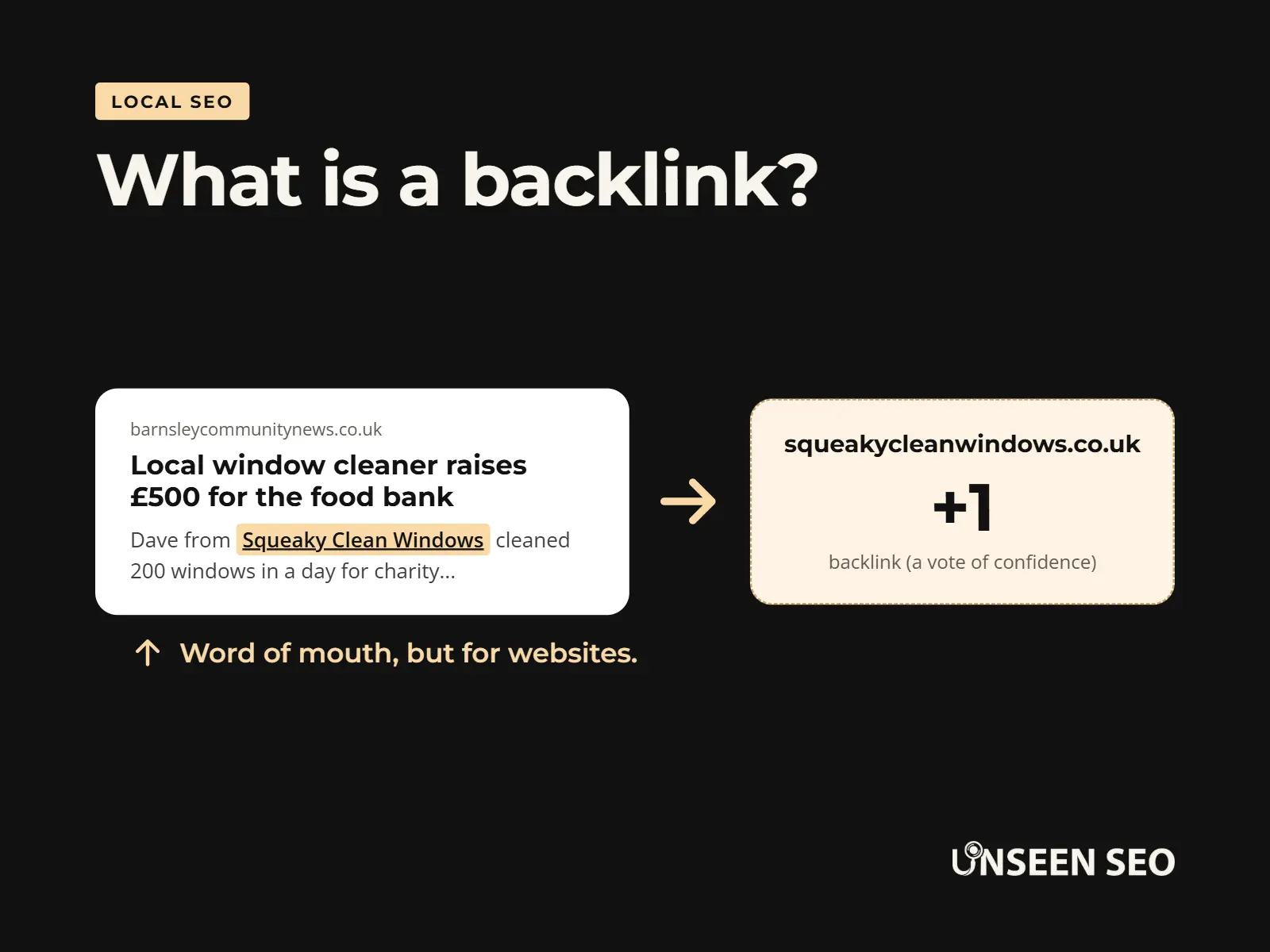
A backlink, in one picture
barnsleycommunitynews.co.uk
Local window cleaner raises £500 for the food bank
Dave from Squeaky Clean Windows cleaned 200 windows in a day for charity, and local residents were quick to get involved.
↓
A made-up business and a made-up news site, just to show the idea.
The words you click on are called the anchor text. A link can also be an image, a logo or a button. If clicking it takes someone from their website to yours, it counts.
Backlinks vs internal links
A backlink comes from a different website. A link from one page on your website to another page on your own website is an internal link. Both are useful, but they do different jobs. Backlinks are other people vouching for you. Internal links are you showing Google (and visitors) around your own site.
Why do backlinks matter?
Think of the best plumber in your town. You probably didn’t find them through an advert. Someone you trust recommended them, then someone else did, and suddenly everybody’s using them.
Google works in a similar way. Its own guidance says it uses links as a signal when working out how relevant a page is, and to find new pages in the first place. When other websites link to yours, especially trusted and relevant ones, it’s a sign your website is worth showing.
Backlinks help in three ways:
- Trust. Links from respected websites act like recommendations
- Discovery. Google finds new pages by following links, so a link can help a brand new page get noticed sooner
- Real visitors. People click links. A link from a busy local website can send you customers directly, whatever Google thinks of it
That’s why SEO people go on about them so much. Links have been part of how Google ranks pages since the very beginning. They still matter today, but they’re one ranking factor among many, and Google has said in recent years that they matter less than many people assume. For a local business, a strong Google Business Profile and genuine reviews often count for more.
Types of backlinks
Not every link is equal. Here are the main types you’ll come across:
| Type | What it is | Does it help? |
|---|---|---|
| Editorial link | Someone links to you in an article because they want to, like a news story or a blog post | Yes, these are the most valuable |
| Directory or profile link | Your listing on a directory, trade body or business profile | Yes, if it’s a directory real people use |
| Nofollow link | A link with a tag telling Google not to pass on credit | Not much for rankings, but can still bring visitors |
| Sponsored link | A paid link, marked as paid | Not for rankings, but fine and within the rules |
| UGC link | A link in user-generated content like comments or forum posts | Very little, and easy to overdo |
| Bought or spammy link | A link paid for or created just to game Google, not marked as paid | No, and it can count against you |
You don’t need to tag or manage any of this yourself. Whoever owns the website that links to you decides how their link is set up. Google’s guidance is that paid links should be marked with rel="sponsored" (or rel="nofollow"), and links in comments or forums with rel="ugc". More on that in our glossary entry on nofollow links.
Good backlinks vs bad backlinks
Here’s where a lot of small business owners get talked into wasting money. It’s quality, not quantity. One link from a genuinely relevant local website is worth far more than fifty from random websites nobody visits.
A good backlink usually ticks most of these boxes:
- Relevant. It comes from a website connected to your trade, your area or your customers
- Trusted. It’s a real website that real people use, not something built just to sell links
- Natural. Someone linked to you because it made sense, not because a deal was done
- Useful to a reader. Someone might actually click it and be glad they did
Good links vs bad links
Worth having
- ✓ Your local news site covering something you did
- ✓ A trade body’s member directory
- ✓ A supplier’s “where to buy” page
- ✓ A local charity thanking its sponsors
- ✓ A blogger recommending you because they liked your work
Not worth the risk
- ✗ “500 backlinks” packages from someone you’ve never heard of
- ✗ Paying a website to link to you without it being marked as paid
- ✗ Spammy directories that list anyone and everything
- ✗ Swapping links with dozens of random websites
- ✗ Comments on blogs and forums just to drop your link
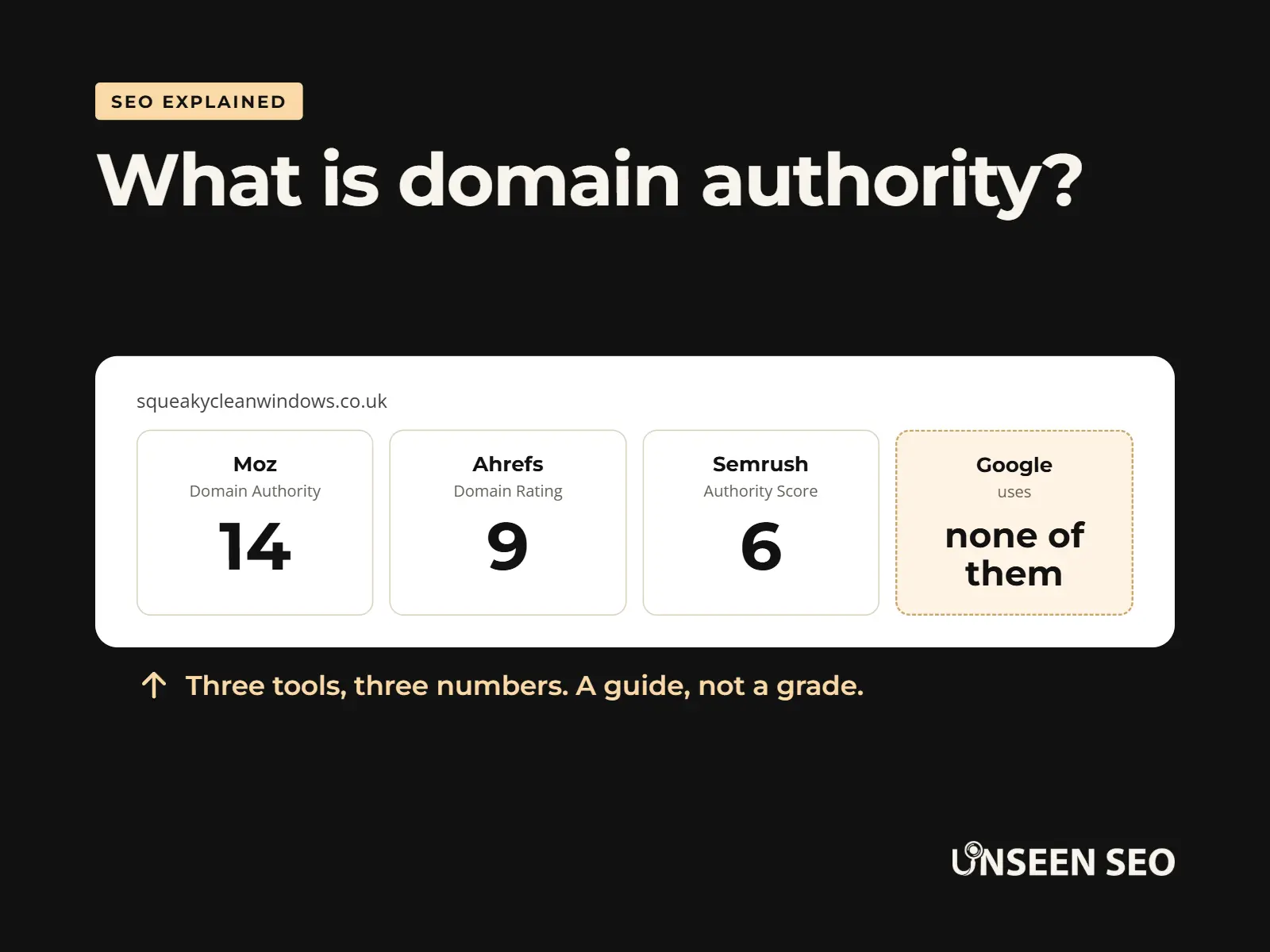
Tools like Moz and Ahrefs give websites a score based mostly on their links, such as domain authority. Those scores can be a handy rough guide to how strong a linking website is, but Google doesn’t use them, so don’t chase links just because a website has a big number.
How many backlinks do you need?
There’s no magic number, and anyone who gives you one is guessing. It depends on how competitive your searches are.
A national online shop might need thousands. A window cleaner in Barnsley competing with five other window cleaners might be doing brilliantly with a couple of dozen good local links. The best way to find out where you stand:
- Search Google for your main service and town, like “window cleaner Barnsley”
- Note the businesses that show up near the top
- Put their web addresses into a free backlink checker (see below) and see roughly how many websites link to them
- If you’re in the same ballpark, links probably aren’t what’s holding you back. Look at your pages, your Google Business Profile and your reviews instead
Count the number of different websites linking to you, not the total number of links. Fifty links from one website count for much less than one link each from fifty different websites.
How to check your backlinks
You can see who links to you for free:
- Google Search Console. The Links report shows your top linking websites and your most-linked pages. It’s free and comes straight from Google. If you haven’t set it up yet, here’s how to set up Google Search Console
- Ahrefs’ free backlink checker. Shows a sample of the links pointing at any website, yours or a competitor’s
- Moz’s free tools. Show a sample of your links alongside your domain authority
Every tool finds a slightly different set of links, so don’t panic if the numbers don’t match. And if a brand new website shows zero, that’s normal. Everyone starts there.
How to get backlinks for a small business
Good news: the links that help local businesses most are usually the easiest to get. You don’t need a big budget or a PR team. Start at the top of this list and work down:
- Your Google Business Profile. Not a classic backlink, but it’s the foundation for local search. Get it set up properly first
- Proper directories. Trusted directories for your trade and your area, plus well-known ones like Yell, Bing Places and Apple Business Connect. These are called local citations. Keep your business name, address and phone number exactly the same on every one (NAP consistency)
- Trade bodies and accreditations. If you’re a member of a trade association or certification scheme, check they list you with a link
- Suppliers and partners. Many suppliers have “stockists” or “approved installers” pages. Businesses you work alongside (a wedding photographer and a florist, say) can recommend each other where it genuinely makes sense
- Local sponsorship and charity. Sponsoring a junior football team, a school fair or a charity event often comes with a thank-you link on their website
- Local news. Local papers and community websites want local stories. A milestone, a new service, a charity effort or an interesting customer project can all earn coverage, and usually a link
- Unlinked mentions. Search Google for your business name. If a website mentions you without linking, a polite email asking them to add a link often works
- Helpful content. A genuinely useful guide, like “how often should you clean your windows?”, gives people a reason to link to you without being asked. A content strategy turns this into a habit
None of that needs a marketing degree. It’s mostly being visible and getting on well with people, which most small business owners are already rather good at.
How to ask for a link
Keep it short and friendly. Something like:
“Hi Sarah, thanks for listing us on your recommended suppliers page. Would you mind adding a link to our website, squeakycleanwindows.co.uk? It helps local customers find us. Thanks, Dave”
That’s it. No grovelling, no SEO jargon. Most people say yes, especially if you’ve helped them in the past.
What to avoid
Google’s spam policies call out “link spam”: creating links mainly to manipulate rankings. Websites that break the rules may rank lower or not appear in results at all. The main things to steer clear of:
- Buying links that aren’t marked as paid, including swapping free products or services for a link
- Link packages promising hundreds of backlinks for a few pounds. They’re almost always from low-quality websites built to sell links
- Mass link swaps (“I’ll link to you if you link to me”) with websites that have nothing to do with you
- Automated tools that create links for you
- Low-quality directories that list absolutely anyone
- Spamming comments on blogs and forums with your link
Don’t panic about strange links you didn’t ask for, though. Every website picks up a few odd ones, and Google is generally good at ignoring them. It’s the ones you go out and build to game the system that cause trouble.
And if someone emails promising “high DA backlinks” or “page one in 30 days”, you can safely hit delete. If it sounds too good to be true, it’s because it is.
Common questions about backlinks
Quick answers to the questions people ask Google most about backlinks.
A backlink is a link on another website that points to yours. In SEO, backlinks matter because Google uses links as one of the ways it works out which pages are useful and trustworthy. They’re also called inbound links or incoming links.
If your local newspaper writes about your business and links to your website, that’s a backlink. So is a supplier listing you on their “stockists” page with a link, or a trade association linking to you from its member directory.
Most are good or harmless. Genuine links from relevant websites help. Links that are bought, swapped in bulk or created automatically to game Google break its spam policies, and building lots of those can hurt your rankings. Google is generally good at ignoring random spammy links you didn’t ask for.
Start with the easy ones: your Google Business Profile, trusted directories for your trade and area, suppliers, trade bodies and local organisations you’re part of. Then earn more by sponsoring local events, getting local press for genuine news, and writing helpful content people want to share.
For a small local business, the best way is to ask people you already have a real connection with: suppliers, partners, clubs, charities and local business groups. These links are relevant, easy to get, and exactly the kind Google trusts.
Earning backlinks costs time rather than money. Paying for links that pass ranking credit goes against Google’s spam policies unless the link is marked as sponsored, and cheap link packages are usually low-quality sites. A sponsorship or paid listing can still be worthwhile for the customers it brings in.
Yes. Google still uses links to find pages and to help judge how relevant and trustworthy they are. But they’re one signal among many. For local searches, your Google Business Profile, reviews and useful pages often matter more than how many links you have.
There’s no magic number. A local business often needs far fewer than people expect, and a handful of good, relevant links can do more than hundreds of poor ones. Compare yourself with the businesses that rank for your main searches rather than chasing a target.
Google Search Console’s Links report shows which websites link to you, for free. Ahrefs’ free backlink checker and Moz’s free tools show a sample too. Different tools find different links, so don’t worry if the numbers don’t match.
Yes. Most of the links that help small local businesses come from relationships you already have, so you’re often the best person to ask for them. It takes a bit of time and a few friendly emails, not special tools.
The 30-second version
A backlink is a link from another website to yours. Google uses links as one of the signals of trust and relevance, and they help it find your pages. Quality beats quantity: a few relevant local links (directories, suppliers, trade bodies, local news, sponsorships) are worth far more than hundreds of random ones. Check yours for free in Google Search Console. Never buy links or use link schemes, and remember that for local searches your Google Business Profile and reviews matter just as much.
Want a hand with it?
Not sure whether your website has decent backlinks, or any at all? Our £150 No Nonsense Audit checks who links to you, compares you with the local competitors that outrank you, and tells you in plain English what’s worth doing next. No retainer, no contract. If you’d rather work through a link plan together, that’s £50 an hour. Or just drop us a message.

Leave a Reply