
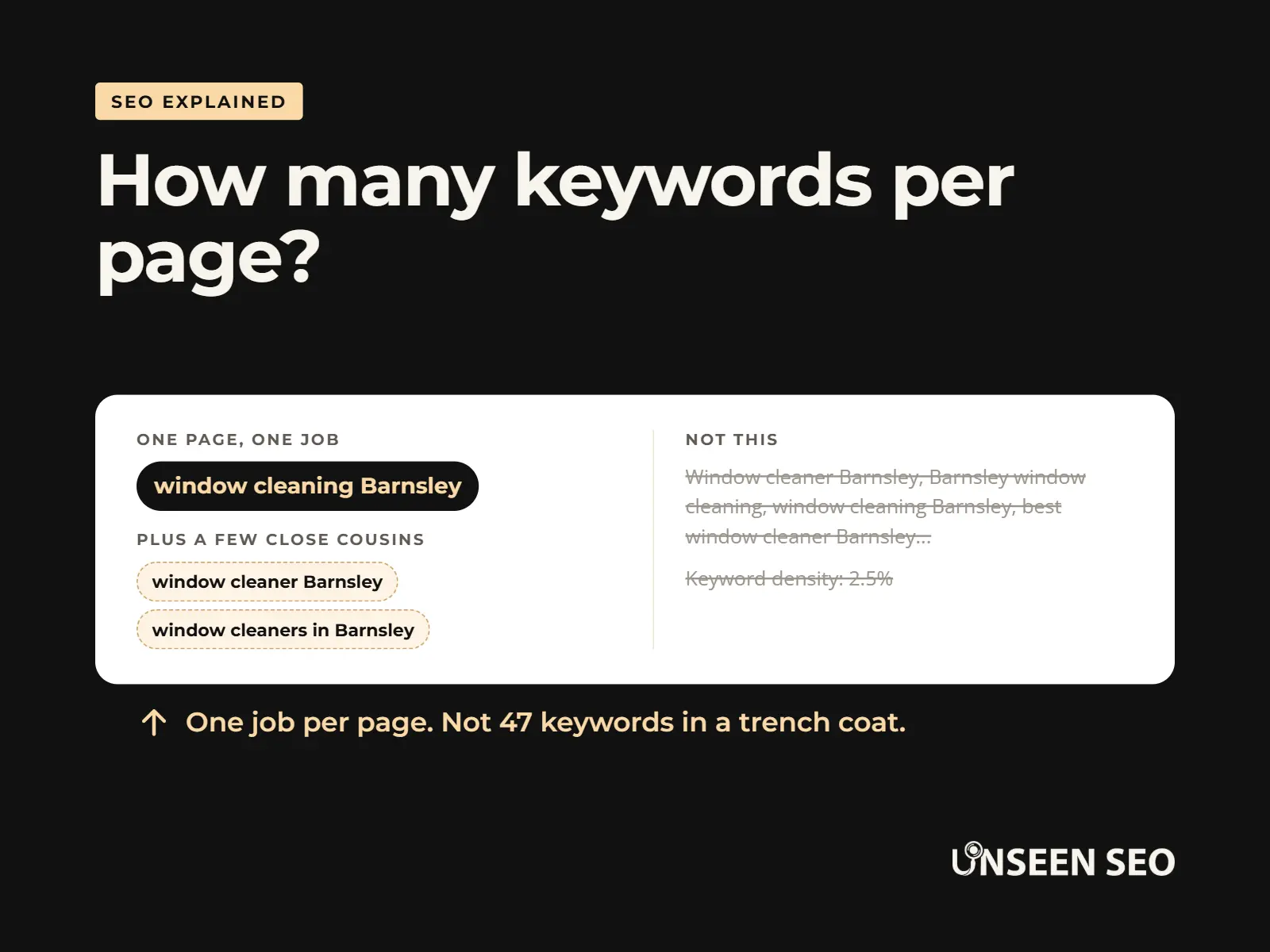
The simple answer: one main keyword per page, plus a few close variations of it. That’s it. No spreadsheets, no percentages, and definitely no repeating the same phrase until your page reads like a parrot wrote it.
This guide explains how many keywords to target on one page, where to put them, how to tell when two keywords need separate pages, and what keyword stuffing looks like (so you can steer well clear of it).
Contents
- The short answer: one main keyword per page
- Why one topic per page works
- Same page or separate pages?
- Where to put your keyword
- How many times should you use it?
- What is keyword stuffing?
- How one page ranks for hundreds of searches
- An example, start to finish
- Mistakes to avoid
- Common questions
The short answer: one main keyword per page
Give every important page one main keyword: the search you most want it to show up for. Then add a few close variations that mean the same thing, like “window cleaner Barnsley” and “window cleaning in Barnsley”.
Think of the main keyword as the page’s job title. A page can mention plenty of related things, but it should have one clear job. A page that tries to be about everything usually ends up ranking for nothing.
If you’re not sure what your main keywords should be yet, start with our guide to keyword research. It shows you how to find the words your customers actually type, for free.
Why one topic per page works
Google’s job is to show the single most useful page for each search. A page that’s clearly about one thing is much easier for Google to understand, and much more likely to be the best answer.
It works better for customers too. Someone searching “gutter cleaning Barnsley” wants a page about gutter cleaning, not a page about windows that mentions gutters in paragraph nine. Matching what the searcher actually wants is called search intent, and it matters more than any keyword count.
Same page or separate pages?
This is where most people get stuck. Here’s a simple test: search for both keywords on Google and compare the results.
- If the results are mostly the same pages, Google sees them as the same topic. Use one page
- If the results are mostly different, Google sees them as different topics. Use separate pages
| Keywords | Same page or separate? | Why |
|---|---|---|
| window cleaner Barnsley / window cleaning Barnsley | Same page | Same service, same searcher, just worded differently |
| window cleaning Barnsley / gutter cleaning Barnsley | Separate pages | Different services. Someone wanting gutters cleared wants a gutter page |
| window cleaning Barnsley / window cleaning Rotherham | Separate pages (if you genuinely work there) | Different places, different searchers. Each page needs real local detail |
| how much does window cleaning cost / window cleaning prices | Same page | Same question, different words |
| window cleaning Barnsley / how to clean windows without streaks | Separate pages | One wants to hire someone, the other wants to do it themselves |
Two pages chasing the same keyword can end up competing with each other, so neither does as well as one strong page would. If you’ve got two pages that are basically about the same thing, merge them into one better page.
Where to put your keyword
Once you’ve chosen a main keyword, use it (or something very close) in these places:
- The page title: the clickable headline in Google. Near the start if it reads naturally. More on meta titles
- The main heading (H1): the big heading at the top of the page
- The first paragraph, so visitors and Google know straight away what the page is about
- The web address, sometimes called the URL slug: /window-cleaning-barnsley/ beats /page-id-482/
- A subheading or two, where it fits
- The meta description, the short text under your title in Google. It doesn’t directly affect ranking, but it helps people click. More on meta descriptions
- Image alt text, if the image genuinely shows it. That’s the short description of an image for people who can’t see it (alt text)
That’s plenty. After that, just write the page properly for the person reading it.
How many times should you use it?
There’s no magic number. You’ll sometimes hear about “keyword density” (the idea that your keyword should make up, say, 2% of the words on a page). It’s an old myth. Google has said for years that there’s no ideal keyword density to aim for.
A better test: read the page out loud. If a phrase starts to sound odd because you’ve said it so many times, you’ve used it too often. If someone reading it would struggle to tell what the page is about, you’ve probably not used it enough.
What is keyword stuffing?
Keyword stuffing is cramming keywords into a page to try to rank higher. Google defines it as filling a web page with keywords or numbers to manipulate rankings, and it’s against Google’s spam policies.
Google’s own examples include:
- Repeating the same words or phrases so often that it sounds unnatural
- Blocks of text listing cities and regions a page is trying to rank for (the classic “We cover Barnsley, Rotherham, Doncaster, Wakefield, Penistone…” list of 40 places at the bottom of a page)
- Lists of phone numbers without any real value
Other versions you’ll still see: page titles with the keyword three times over, keywords hidden in white text on a white background, and alt text stuffed with search terms that don’t describe the picture.
Same page, two ways of writing it
Stuffed
Looking for a window cleaner Barnsley? Our window cleaning Barnsley service is the best window cleaner in Barnsley. Call the Barnsley window cleaner today for window cleaning Barnsley.
Natural
We’re a friendly window cleaning service covering Barnsley and the villages around it. We clean frames, sills and conservatory roofs too, and we’ll text you the day before we’re due.
A made-up Barnsley window cleaner. The second version says more, sounds human, and still makes the topic obvious.
Google says sites that break its spam policies may rank lower or not appear in results at all. And even if it didn’t, stuffed text puts customers off. There’s no point ranking first if the page makes people click away.
How one page ranks for hundreds of searches
Here’s the bit that surprises people: a good page doesn’t rank for one keyword. It ranks for dozens, sometimes hundreds, of related searches, without you having to list them all.
Google understands that “window cleaner”, “window cleaning”, “someone to clean my windows” and “conservatory roof cleaning” are all related. So if your page covers the topic properly, answering the questions people actually have, it will start showing up for all sorts of variations, including the longer, more specific ones (often called long-tail keywords).
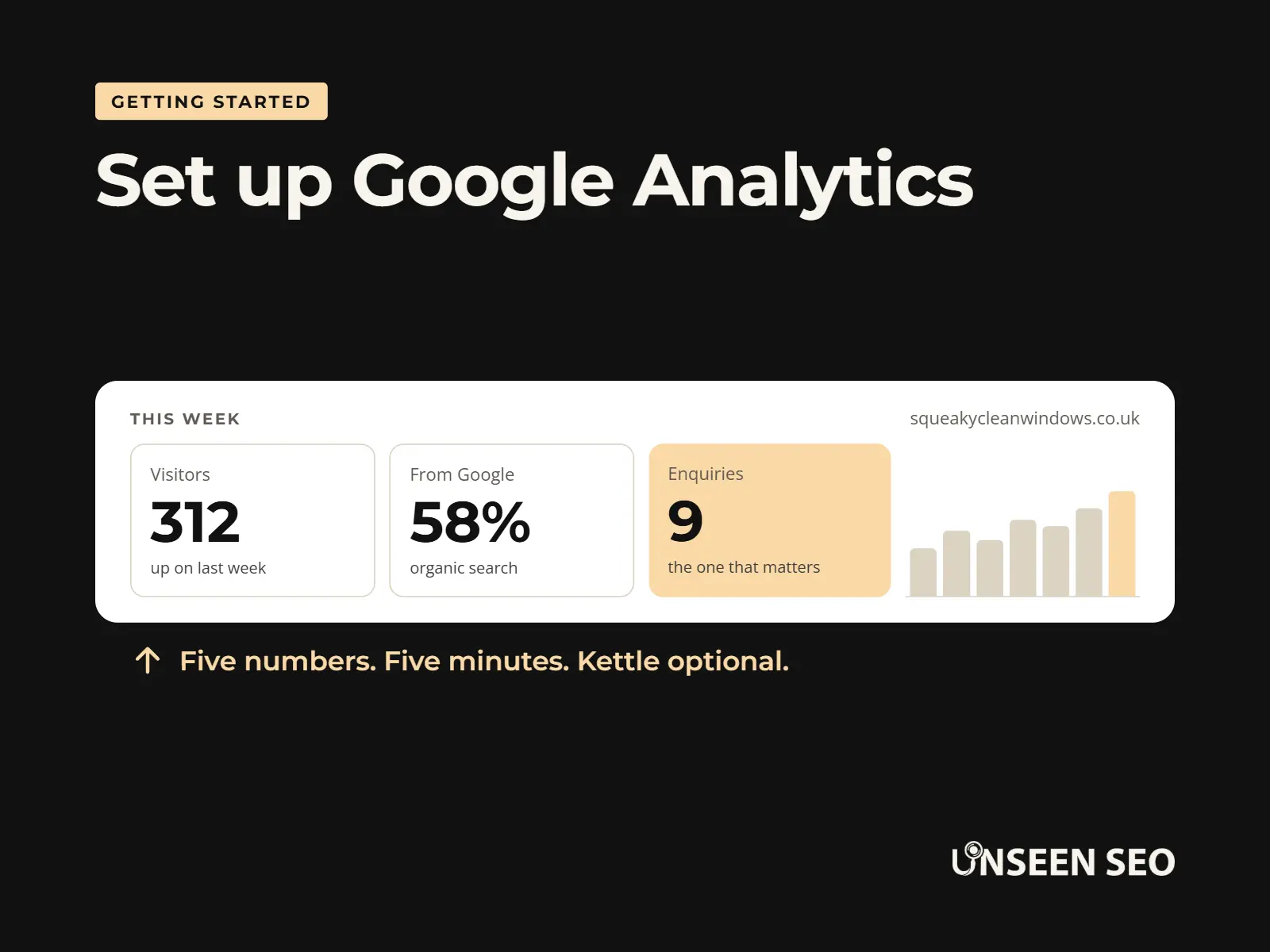
You can see this for yourself in Google Search Console. The Performance report usually shows a surprising number of searches for each page, many you’d never have thought of.
This is also why thin content struggles. A three-line page can’t cover a topic properly, so it doesn’t get the chance to show up for much at all.
An example, start to finish
Say you’re a window cleaner in Barnsley planning your main service page.
- Main keyword: window cleaning Barnsley
- Close variations: window cleaner Barnsley, window cleaners in Barnsley
- Related topics to cover: how often you clean, what’s included (frames, sills), conservatory roofs, prices or how to get a quote, the areas you cover, how to book
- Page title: Window Cleaning in Barnsley | Squeaky Clean Windows
- H1: Window cleaning in Barnsley
- Web address: /window-cleaning-barnsley/
- Separate pages for: gutter cleaning, and any other service people search for on its own
Notice there’s no target number of mentions. The keyword goes in the important places, and the rest of the page is spent being genuinely useful. That’s what tends to rank.
Mistakes to avoid
- One page for every service. A single “Services” page listing everything can’t rank well for any of them
- Several pages for the same thing. They compete with each other. Merge them
- Chasing a keyword density. There’s no magic percentage. Write for people
- Town lists. A paragraph listing 30 towns is keyword stuffing, and it fools nobody
- Identical location pages. Ten pages with only the town name swapped are thin, near-duplicate content
- Forgetting the obvious places. No keyword in the title or main heading makes Google’s job harder than it needs to be
Common questions about keywords on a page
Quick answers to the questions people ask Google most about how many keywords to use.
Focus each page on one main keyword (or topic), plus a few close variations that mean the same thing. There’s no magic number, but if you’re trying to squeeze in more than a handful of different ideas, they probably belong on separate pages.
As many times as reads naturally, and no more. Use it in the page title, main heading and opening paragraph, then just write normally. Google has said for years there’s no ideal number of repetitions to aim for.
There isn’t a rule. “Keyword density” (the percentage of words that are your keyword) is an old idea that Google doesn’t use as a target. Write a useful page about the topic and the right words will appear naturally.
Keyword stuffing is cramming a page with keywords to try to rank higher. Google’s examples include repeating the same words or phrases so often it sounds unnatural, and blocks of text listing every town or city a page is trying to rank for.
Yes. It’s against Google’s spam policies, it reads badly to customers, and it can make your page less likely to rank, not more. Google says sites that break its spam policies may rank lower or not appear in results at all.
It can. Google’s systems are designed to spot it, and pages that rely on it may rank lower or be left out of results. Even when it isn’t penalised, stuffed text puts visitors off, which defeats the point of ranking.
Repeating “plumber Sheffield” in every sentence, a list of 30 towns at the bottom of a page, a page title like “Plumber Sheffield, Sheffield Plumber, Plumbers Sheffield”, or hiding keywords in white text on a white background.
It’s best not to. If two of your pages chase the same search, they can end up competing with each other and neither does as well as one strong page would. Pick one page for each main keyword and link to it from the others.
It’s the idea that roughly 80% of your results come from 20% of your effort. In practice: work out which few pages and searches matter most to your business (usually your main services) and get those right before worrying about the rest.
The 30-second version
Give each page one main keyword and a few close variations. Put it in the page title, main heading, first paragraph and web address, then write naturally for the person reading. If two keywords bring up different results on Google, they need separate pages. Forget keyword density, never list towns or repeat phrases to game Google, and remember that a genuinely useful page will rank for far more searches than you could ever list.
Want a hand with it?
Not sure which keywords each of your pages should target, or whether your pages are competing with each other? Our £150 No Nonsense Audit checks what each page is trying to rank for and what’s getting in the way, then tells you in plain English what to fix first. Or our content strategy help (£50 an hour) can map out which page should target what. No retainer, no contract. Or just drop us a message.


Leave a Reply