Domain authority is a score from 1 to 100 that an SEO software company invented to guess how well a website might rank. It’s free to check, Google doesn’t use it, and for most small businesses it’s the last thing you need to lose sleep over.
This guide explains what domain authority actually is, how it’s worked out, what counts as a good score for a small business, and the honest way to improve it, without falling for anyone selling “high DA links”.
Contents
- What is domain authority?
- Does Google use domain authority?
- How is domain authority worked out?
- Domain authority vs domain rating vs authority score
- What’s a good domain authority score?
- How to check your domain authority
- How to improve it (the honest way)
- Should you worry about your score?
- Common questions
What is domain authority?
Domain Authority (often shortened to DA) is a score created by Moz, a company that makes SEO software. It runs from 1 to 100, and it’s Moz’s prediction of how likely a website is to rank in search results compared with other websites.
The higher the score, the stronger Moz thinks the website is. A brand new website starts at 1. Huge sites like the BBC or Wikipedia sit near the top.
The important word there is prediction. Domain authority isn’t something Google gives you. It’s one company’s educated guess, worked out from data it collects itself.
One website, three different scores
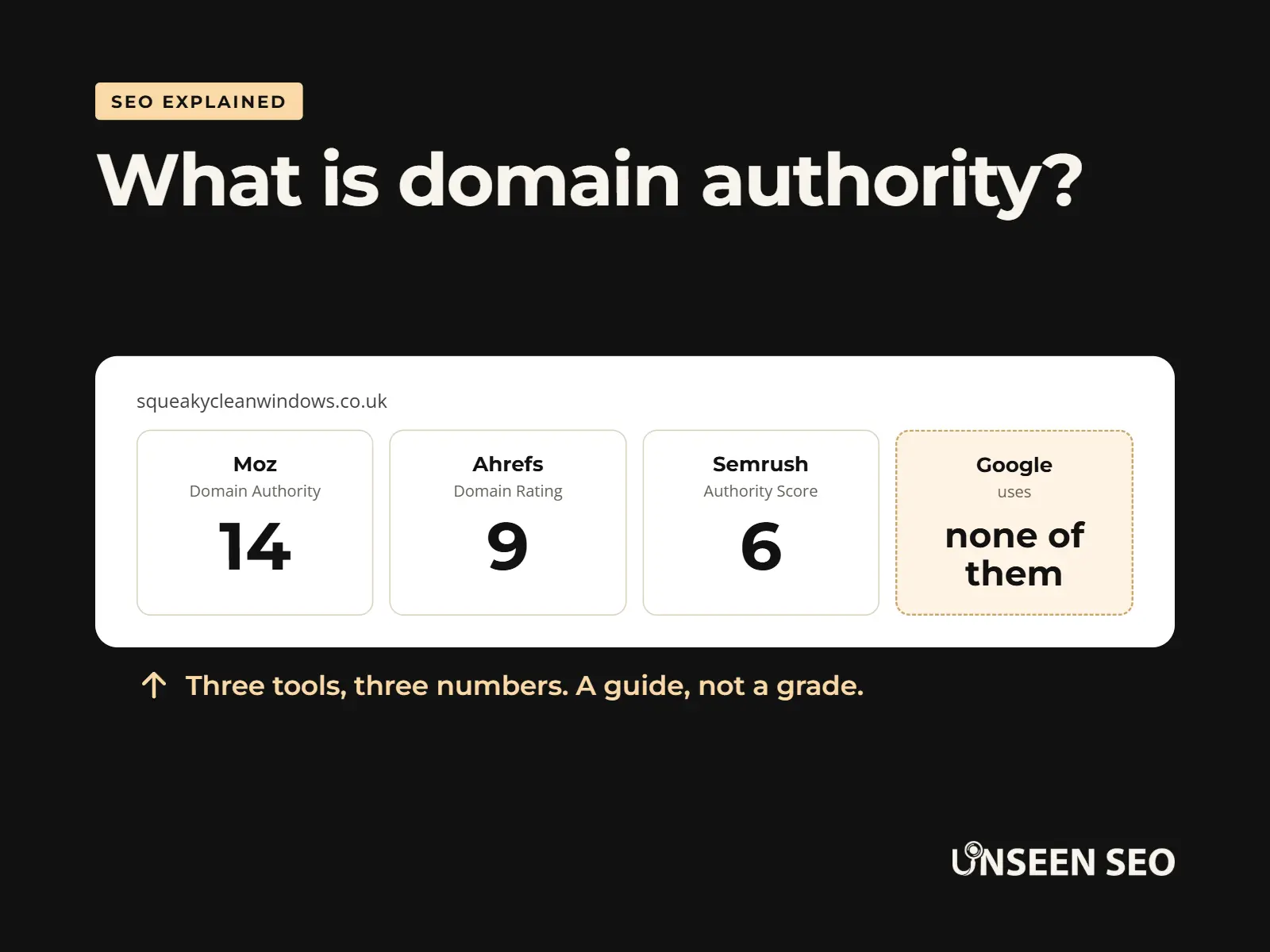
squeakycleanwindows.co.uk
Moz
Domain Authority
14
Ahrefs
Domain Rating
9
Semrush
Authority Score
6
A made-up website with made-up scores, to show that each tool works its number out differently.
Does Google use domain authority?
No. This is the bit that gets lost. Moz is clear that Domain Authority isn’t a Google ranking factor, and Google doesn’t use it, or any other tool’s version of it, to decide where websites appear.
So why does anyone care? Because the score is built from things Google does pay attention to, mainly links from other websites. That makes it a handy rough guide for comparing websites. It just isn’t the thing itself. It’s a bit like a weather app’s forecast: useful, often right, but it doesn’t control the weather.
How is domain authority worked out?
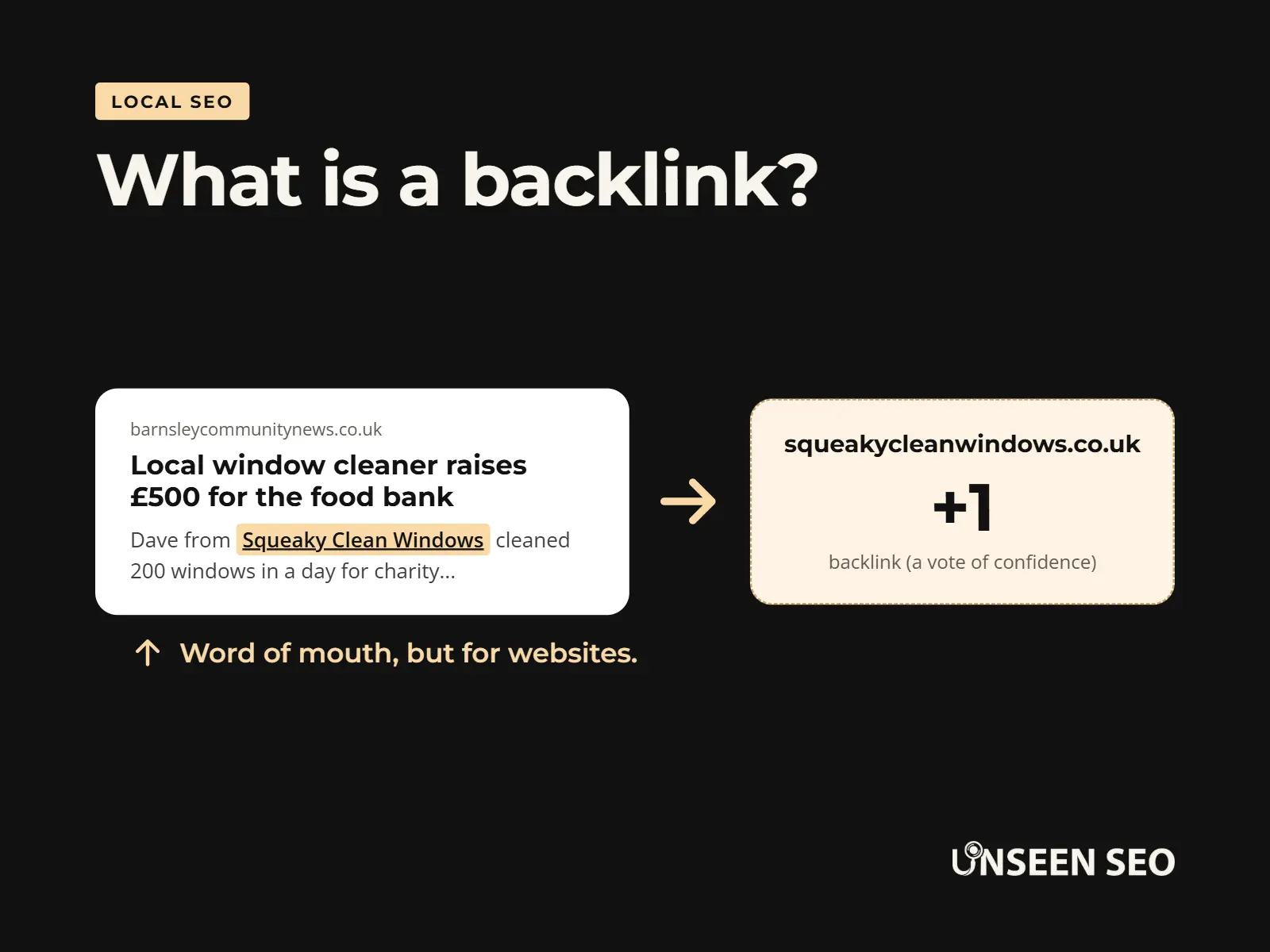
Moz doesn’t publish its exact formula, but the main ingredient is links: other websites linking to yours. These are called backlinks. The score looks at things like:
- How many different websites link to you, rather than the total number of links
- How strong those websites are. A link from a well-known site counts for more than one from a brand new blog
- Whether the links look natural, or look like they’ve been bought or swapped in bulk
A few things worth knowing about how the score behaves:
- It’s on a sliding scale. Going from 10 to 20 is much easier than going from 60 to 70
- It’s relative. Your score can drop even if nothing changed on your site, simply because other websites gained links faster
- It updates with the tool. When Moz changes how it calculates scores, lots of websites move up or down at once
Domain authority vs domain rating vs authority score
Moz isn’t the only one doing this. Most big SEO tools have their own version, with a different name and a different number:
| Tool | Score name | Scale | Mainly based on |
|---|---|---|---|
| Moz | Domain Authority (DA) | 1 to 100 | Links from other websites |
| Ahrefs | Domain Rating (DR) | 0 to 100 | Links from other websites |
| Semrush | Authority Score (AS) | 0 to 100 | Links, plus estimated traffic |
| Majestic | Trust Flow and Citation Flow | 0 to 100 | Links, and how trustworthy they look |
Because each tool uses its own data and formula, the same website gets a different score in each one. That’s why you should pick one tool and stick with it if you’re tracking your score over time. Comparing your Moz DA with a competitor’s Ahrefs DR tells you nothing at all.
What’s a good domain authority score?
There’s no single “good” number. A score only means something compared with the websites you’re competing against.
Most small local business websites have fairly low scores, and that’s completely normal. A window cleaner in Barnsley isn’t competing with Amazon. They’re competing with the other window cleaners in Barnsley, who probably have low scores too.
So the useful question isn’t “is my score good?” It’s “how does my score compare with the businesses that show up when people search for what I do?” To find out:
- Search for your main service and town, like “window cleaner Barnsley”
- Note the websites that show up near the top
- Check their scores in the same tool you use for yours
- If you’re in the same ballpark, your score isn’t what’s holding you back. Look at your content, your Google Business Profile and your reviews instead
You’ll often find websites with lower scores ranking above ones with higher scores. That’s because Google looks at hundreds of things, including how relevant and useful the page is, and, for local searches, how close the business is to the person searching.
How to check your domain authority
You can check it for free in a few seconds. Type your web address into one of these:
- Moz’s free domain checker shows Domain Authority, and a few other basics, with a free account
- Ahrefs’ free Website Authority Checker shows Domain Rating and how many websites link to you
- Semrush shows Authority Score with a free account, with a limited number of checks each day
Don’t be alarmed if a new website shows a score of 1 or 0. That just means the tool hasn’t found many links to it yet. Every website starts there.
How to improve it (the honest way)
Since the score is mostly about links, the way to improve it is to earn genuine links from other relevant websites. For a small local business, that usually means:
- Local directories and listings. Your Google Business Profile first, then trusted directories for your trade or area, with your name, address and phone number written exactly the same everywhere (NAP consistency)
- People you already work with. Suppliers, trade bodies, partners and local businesses you recommend each other to
- Local community. Sponsoring a local team or event, or helping a local charity, often comes with a mention and a link
- Local news. A genuinely interesting story, like a milestone, a new service or a community project, can earn coverage
- Useful content. Helpful guides and answers to customer questions give people a reason to link to you. A content strategy makes this a habit rather than an accident
What not to do: don’t buy links. You’ll get emails offering “DA 50+ backlinks” for a few pounds each. They’re almost always from websites built purely to sell links, and buying links to manipulate rankings is against Google’s spam policies. You might nudge up a third-party score, but you’re risking your actual Google rankings to do it. Not a great trade.
Should you worry about your score?
For most small businesses, no. It’s a useful number for comparing yourself with competitors now and then, but it’s not a goal in its own right, and it’s not what Google uses.
Your time is usually far better spent on the things that directly affect whether customers find and choose you:
- A complete Google Business Profile and genuine reviews
- A proper page for each main service, written for what people actually search
- Making sure Google can find your pages at all (if it can’t, start with why your business might not be showing up on Google)
- Tracking real results in Google Search Console: clicks, searches and enquiries
Get those right and your domain authority will usually creep up on its own as people start linking to you. Which is exactly how it’s supposed to work.
Common questions about domain authority
Quick answers to the questions people ask Google most about domain authority.
Domain authority (DA) is a score from 1 to 100 created by the SEO software company Moz. It estimates how likely a website is to rank on Google compared with other websites, based mainly on the links pointing to it from other sites. It’s a third-party prediction, not something Google uses.
No. Domain authority is Moz’s own metric, and Google doesn’t use it, or any other tool’s score, to rank websites. Google does look at links and signals of trust in its own ways, which is why the score can be a rough guide, but the number itself has no effect on your rankings.
It depends entirely on who you’re up against. For a small local business, 30 would usually be strong, as many local websites score well below that. For a national brand or news site, it would be low. Compare your score with the businesses that show up for the searches you want, not with a fixed number.
Put your web address into Moz’s free domain checker to see your Domain Authority. Ahrefs has a free Website Authority Checker that shows its own version, Domain Rating, and Semrush shows an Authority Score. Each tool gives a different number, so stick to one when tracking changes.
As a quick way to compare websites, it can be handy. As a goal in itself, not really. Google doesn’t use it, and a business with a modest score but a great Google Business Profile, useful pages and good reviews can easily outrank a bigger site locally.
By earning genuine links from other relevant, trustworthy websites, such as local directories, suppliers, partners, local news and organisations you’re involved with. Creating useful content that people want to link to helps too. Buying links or using link schemes breaks Google’s rules and isn’t worth the risk.
They’re similar scores from different companies. Domain Authority is Moz’s; Domain Rating is Ahrefs’. Both look mainly at links, but they use different data and formulas, so the same website will get a different number in each. Neither is used by Google.
Usually not because of anything you did. Scores are relative, so they can dip when other websites gain links faster, when you lose a few links, or when the tool updates how it calculates scores. If your enquiries and Google traffic are steady, a small drop isn’t worth worrying about.
No. Buying or swapping links to manipulate rankings goes against Google’s spam policies, and offers of “DA 50+ links” are usually low-quality sites built for selling links. You might push up a third-party score, but you risk your actual Google rankings.
The 30-second version
Domain authority is a 1 to 100 score made by Moz to predict how well a website might rank, based mostly on links from other websites. Google doesn’t use it. Other tools have their own versions (Ahrefs’ Domain Rating, Semrush’s Authority Score), each with different numbers. There’s no universal “good” score: compare yourself with local competitors in one tool. Improve it by earning genuine local links, never by buying them, and spend most of your energy on the things customers actually see.
Want a hand with it?
Not sure whether links (or the lack of them) are what’s holding you back? Our £150 No Nonsense Audit compares your website with the local competitors that outrank you and tells you in plain English what’s actually making the difference, and what to fix first. No retainer, no contract. If you’d rather talk it through, that’s £50 an hour. Or just drop us a message.

Leave a Reply